
Iran has submitted its latest proposal aimed at advancing negotiations to end the ongoing West Asia conflict with the US, days after the Islamic Republic submitted a fresh proposal through regional intermediaries to cease its military operations in the Strait of Hormuz, which is likely to get rejected by Washington.

Prime Minister Narendra Modi has called for the resolution of the West Asia crisis and the Ukraine conflict through dialogue and diplomacy, asserting that military action alone cannot achieve lasting peace. He made the remarks after talks with Norwegian Prime Minister Jonas Gahr Store.

Israeli Prime Minister Benjamin Netanyahu publicly acknowledged India's significant support, directly refuting American Vice President J D Vance's assertion that the US was Israel's only powerful ally. Netanyahu highlighted India's 1.4 billion people and the "tremendous support" received, including on social media, while also noting Israel's strong relationships with other nations seeking its cybersecurity and AI expertise.

The United States and Iran are scheduled to hold their initial round of talks in Switzerland on Friday, following a ceasefire agreement virtually signed by US President Donald Trump and Iranian President Masoud Pezeshkian.

Donald Trump asked countries involved in the peace talks with Iran to sign on to the Abraham Accords, which deal with establishing diplomatic, economic and security ties between Israel and Arab nations.

The Nihangs have called off their planned protest march in Uttarakhand related to a recent dispute at the Karnaprayag market in Chamoli and a gurdwara in Nagrasu.

Iranian Foreign Minister Abbas Araghchi visited Pakistan for the second time in three days amid uncertainty surrounding potential peace talks with the US. The visit follows discussions in Oman regarding regional security and efforts to resolve the Iran-US conflict.

Iran's Foreign Ministry has denied reports of planned talks with the United States during a visit to Islamabad, Pakistan, despite US envoys also visiting the region.

Indian benchmark stock indices, Sensex and Nifty, closed nearly 1 per cent lower following the collapse of US-Iran negotiations, which heightened concerns of a prolonged conflict in West Asia and drove crude oil prices sharply higher.

US President Donald Trump has shared an article suggesting that the option of enforcing a naval blockade was available in the context of Iran, as peace talks ended in a stalemate in Islamabad after differences of opinion arose between the two parties on the Strait of Hormuz and Iran's nuclear capacities.

Sonam Wangchuk has strongly denied allegations of a 'deal' with the Centre, clarifying that he concluded his 26-day hunger strike only after receiving a crucial written assurance.

At the end of this journey, no matter now it ends, these youngsters will know something essential about the Indian government, the Indian judiciary, the Indian media, the Indian police, the Indian laws and indeed about Indian society, asserts Aakar Patel.

'Energy prices would shoot up with the closure of Hormuz again.'

As Tehran and Washington continue with their engagements following the signing of the MoU earlier this month, sources have told Al Arabiya that the two are set to hold the next round of negotiations in Switzerland on June 28 and 29.

US-Iran talks in Islamabad collapsed after 21 hours, exposing deep divisions over nuclear ambitions and sanctions.

Pakistan's Foreign Office has refuted media reports suggesting that its efforts to facilitate peace talks between the US and Iran have stalled, calling the reports baseless and speculative.

Iranian Parliament Speaker Mohammad Bagher Ghalibaf stressed on Friday (local time) that Tehran remains prepared for "full-scale defence" should the US betray the Memorandum of Understanding signed by the two countries last month.

Activist Sonam Wangchuk's health is rapidly deteriorating on his 17th day of hunger strike, prompting widespread appeals from prominent political figures and Bollywood celebrities for him to end his fast and for the government to address the urgent demands for NEET examination reforms.

Pakistan is actively engaged in diplomatic efforts to facilitate negotiations between the US and Iran, with hopes of hosting a second round of talks in Islamabad.

The Congress party has criticised the Modi government over Pakistan's involvement in US-Iran peace talks, calling it a 'monumental setback' for India's diplomatic efforts.

Pakistan has announced its commitment to continue facilitating talks between the United States and Iran, urging both nations to uphold the ceasefire agreement. Deputy Prime Minister Ishaq Dar highlighted Pakistan's role in mediating recent discussions and expressed hope for durable peace and regional stability.

US special envoys Steve Witkoff and Jared Kushner are travelling to Pakistan for direct talks with an Iranian delegation as part of efforts to end the seven-week war, the White House announced.

Iranian Foreign Minister Seyed Abbas Araghchi announced the official end of the war and warned that any Israeli attack on Lebanon would violate an agreement between Iran and the United States. He also stated that negotiations on nuclear issues and sanctions lifting would begin on Saturday, led by Iran's Parliamentary Speaker M B Ghalibaf and US Vice President J D Vance.

'These are children of our own country; they must be heard': Param Vir Chakra Awardee Honorary Captain Yogendra Singh Yadav.

Iran's foreign ministry spokesperson Esmaeil Baqaei on Sunday said that the recent meeting with US officials was the longest round of negotiations they have had in the past year.

Police say timely operation prevented a possible mass-casualty attack.

Iranian news agencies have denied reports of Iranian officials travelling to Pakistan for negotiations with the United States, even as Pakistan prepares for potential talks and faces criticism from Israel.

Trump further alleged that Iran was behind the attacks on three vessels carrying Indian seafarers near the Hormuz Strait, which resulted in the deaths of three, despite the US Central Command having confirmed that the strikes were carried out by American naval forces, calling the incident "totally unacceptable."

Iran blames the US for 'maximalism' and 'shifting goalposts' leading to the collapse of the Islamabad talks.

The United States and Iran could resume negotiations as early as next week in Islamabad, according to a report by The Wall Street Journal citing people familiar with the matter.

Pakistan Prime Minister Shehbaz Sharif clarified that the recent Memorandum of Understanding (MoU) signed between the US and Iran does not include provisions regarding Tehran's ballistic missile programme. This statement followed talks with Iranian President Masoud Pezeshkian, with Sharif emphasising Iran's right to its defence capabilities and Pakistan's role as a mediator in the US-Iran peace process.
Direct talks between the US and Iran, mediated by Pakistan, have failed to produce an agreement after 21 hours of negotiations, with disagreements over Iran's nuclear ambitions and sanctions proving insurmountable.

US Vice President JD Vance has postponed his visit to Switzerland for technical talks with Iranian negotiators, citing logistical issues. These negotiations are crucial for finalising the details of a recently signed peace deal between the US and Iran, which aims to end the conflict in West Asia and includes a 60-day period for technical discussions.

Union Education Minister Dharmendra Pradhan has resigned from his post amidst widespread nationwide protests concerning the NEET-UG 2026 paper leak controversy, citing the larger interest of students and the need to prevent exploitation by anti-national forces. The government is also preparing to introduce a stringent anti-paper leak law.

An Argentine war veterans federation has urged football fans to prioritise the World Cup semi-final against England as a sporting event, rather than using it to reignite sovereignty claims over the Falkland/Malvinas Islands. They emphasised diplomacy for territorial disputes and called for respect for fallen soldiers without promoting hatred.

The Indian government has significantly altered its approach to the Cockroach Janata Party (CJP)-led agitation over the NEET paper leak, moving from dismissal to calibrated political engagement, including promises of fast-track courts, a new anti-paper leak law, and negotiations with key protest leaders.
Doubts are emerging about Pakistan's role in mediating peace negotiations between the US and Iran, with suggestions that Islamabad's efforts are stalling and failing to secure a definitive response from the United States.

The Ministry of External Affairs (MEA) has stated that India is closely monitoring developments in West Asia, addressing topics ranging from ceasefire efforts to maritime security and the safe return of Indian nationals. The MEA also addressed the UN Climate Change Conference and the delimitation bill.

India and Australia have signed significant agreements covering civil nuclear energy, maritime security, and critical minerals, reinforcing their partnership's role in ensuring a peaceful Indo-Pacific. The pacts facilitate uranium supply from Australia to India and enhance cooperation in defence, cyber, and critical technologies.
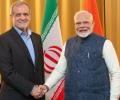
Prime Minister Narendra Modi held a telephonic conversation with Iranian President Masoud Pezeshkian, discussing recent developments in West Asia and reiterating India's emphasis on the importance of freedom of navigation in the Strait of Hormuz. Modi welcomed the recent peace understanding between the US and Iran, stressing dialogue and diplomacy for regional stability. India will also send representatives to the burial ceremonies of Iran's late Supreme Leader.
